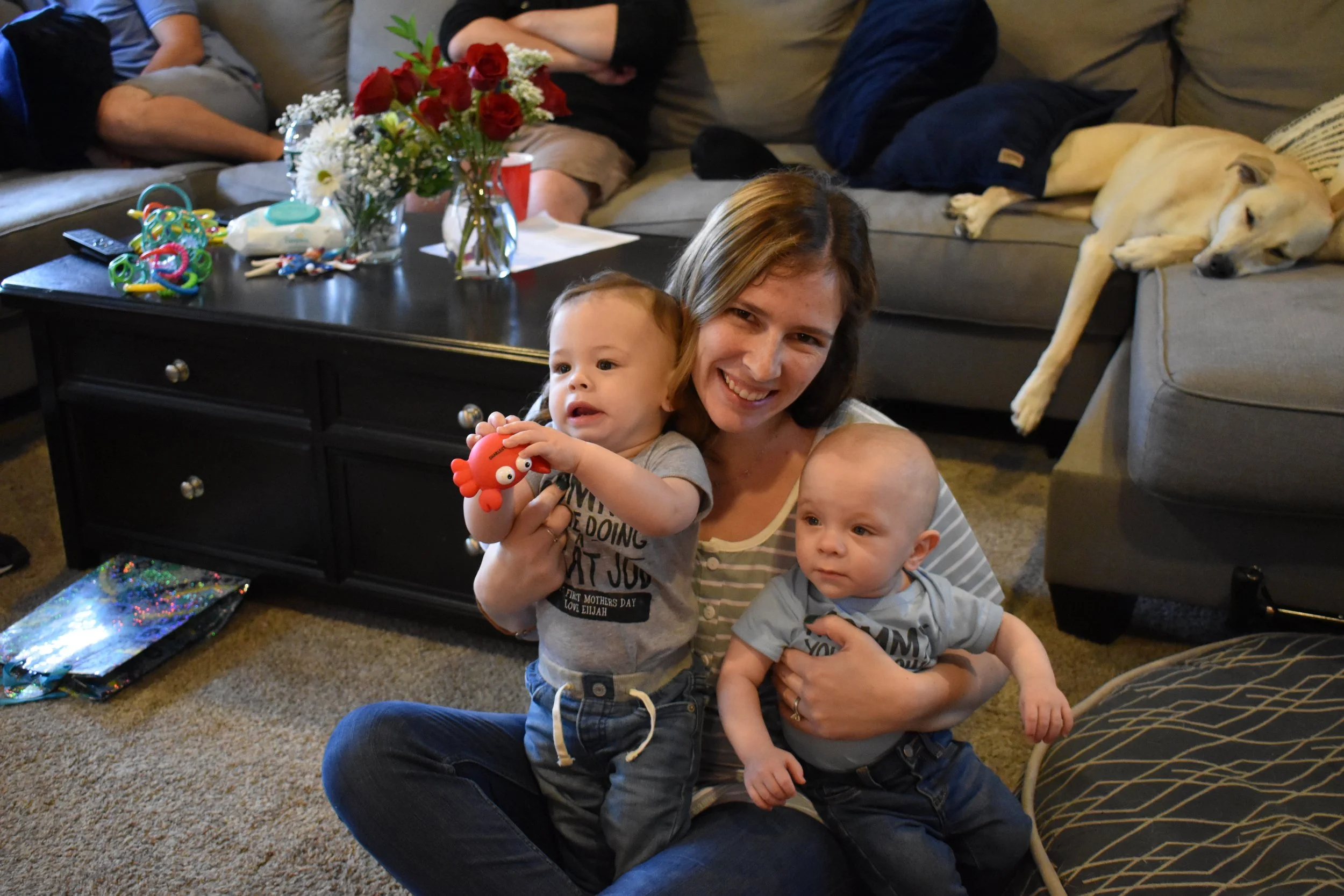
Moms of Multiples
You're Not Just a New Mom.
You're a Mom of Multiples.
That's a Whole Different Thing.
People told you it would be double the love.
What they didn't always mention was double the fear during pregnancy, double the exhaustion in the newborn period, double the guilt when you can't be fully present for both babies at once, and a postpartum experience that looks almost nothing like what the standard new-mom resources describe. You may have spent weeks or months on modified bed rest. You may have delivered early and watched your babies go straight to the NICU. You may be running on almost nothing, holding two babies who need you simultaneously, and wondering in your quiet moments why this doesn't feel the way you thought it would.
You are not ungrateful. You are not failing. You are doing something extraordinarily hard and you deserve support that actually understands that.
What Makes the Multiples Experience Unique
Expecting and parenting multiples is not simply a more intense version of a singleton pregnancy and postpartum. It is a qualitatively different experience, with its own specific emotional, physical, and psychological demands.
During pregnancy:
Higher-risk pregnancy classifications bring more monitoring, more appointments, more fear, and less of the uncomplicated joy that pregnancy "should" feel like
The possibility, or reality, of losing one or more babies in utero, and the complicated grief of continuing a pregnancy after loss within a multiple set
Decisions about selective reduction, which carry profound emotional weight regardless of the choice made
Anticipatory anxiety about preterm birth, NICU stays, and everything that might go wrong
A body that is being asked to do something extraordinary, often while managing significant physical discomfort or medical restrictions
In the NICU:
Multiples are born preterm at significantly higher rates than singletons, meaning NICU stays are common and emotionally devastating
The anguish of having babies in different medical situations, sometimes in different parts of the unit or even different hospitals
Leaving the NICU with one baby while another stays behind or losing one baby while another survives
In the postpartum period:
A level of physical demand that makes standard postpartum self-care advice feel almost laughable
Feeding two or more babies, often simultaneously, with all the complexity and emotional weight that feeding decisions carry
Postpartum mood and anxiety disorders at elevated rates compared to singleton moms
Profound identity disruption — you didn't just become a mother, you became a mother of multiples, which comes with its own social identity, expectations, and pressures
Comparison between babies — developmental differences, temperament differences, and the guilt that comes with noticing them
Grief for the singleton experience you didn't have, which is real even when you love your multiples fiercely
Longer term:
The unique dynamics of raising children who share everything — a birthday, a womb, often a classroom — while also being completely individual people
Your own needs disappearing under the sheer volume of caregiving required
The particular exhaustion of a multiples toddler stage, which is its own category of intensity
Why This Feels Personal to Me
I'm a mom of twins myself. I know what it's like to be pregnant with multiples — the extra monitoring, the fear underneath the excitement, the way strangers react when you tell them. I know the newborn period with two babies at once. I know the particular brand of overwhelm that comes with this life, and I know the particular joy that is also woven through it.
I don't say this to center myself in your experience — I say it because it matters that your therapist doesn't need you to explain why this is hard. I already know. What I want to understand is your specific story, your specific babies, and what you need right now.
What Therapy for Moms of Multiples Can Address
Anxiety and depression during a high-risk multiple pregnancy
Processing a difficult, early, or traumatic delivery
NICU trauma and the emotional aftermath of a preterm birth
Grief following the loss of one or more babies — including the complex grief of a surviving twin or triplet
Postpartum mood disorders in the context of multiples
Identity shifts and the loss of your pre-multiples sense of self
The relentlessness of caregiving and the absence of adequate rest or recovery time
Relationship strain with a partner under the pressure of multiples parenting
The complicated feelings that arise around comparing your babies or not feeling equally connected to each of them
Navigating the toddler and beyond stages with multiples — which brings its own set of emotional demands
You don't have to earn the right to struggle.
Moms of multiples are often met with "you must have your hands full!" and a laugh; as if the difficulty of your life is charming rather than real. It is real. And it deserves real support.
Frequently Asked Questions:
Moms of Multiples
Still have questions? Take a look at the FAQ or reach out anytime. If you’re feeling ready, go ahead and apply.
-
Absolutely. You don't need to have had a crisis to benefit from therapy. Many moms of multiples come to therapy not because something went catastrophically wrong, but because they're navigating an identity shift, carrying a level of exhaustion that isn't sustainable, or simply want a space that's theirs in a season of life that leaves very little room for that. There is no threshold of suffering you have to meet.
-
Yes, and I want you to know that this loss has a name. The loss of a twin, triplet, or other multiple is sometimes called "womb twin survivor" grief, and it is one of the most complex and least supported forms of pregnancy and infant loss. You may be grieving deeply while also caring for a surviving baby, which creates an emotional landscape that is extraordinarily difficult to navigate. This is a space where both of your babies are acknowledged — the one you're raising and the one you lost.
-
Not at all. Many moms of multiples spend the first year or two simply surviving, there's no bandwidth for processing. It's very common to reach a point of relative stability and find that everything you didn't have time to feel is waiting for you. Whenever you arrive, there is space here for it.
-
It is not terrible at all, it is honest, and it is more common than you might think. Grieving the pregnancy you didn't have, the newborn experience that looked nothing like what you imagined, or the early months that were survival mode rather than bliss does not mean you love your children any less. Ambivalence and love are not opposites. This is exactly the kind of thing therapy is for.
-
Yes. Many multiples pregnancies result from fertility treatments, and the emotional complexity of that path. Receiving a multiple pregnancy diagnosis after infertility deserves its own dedicated support. Whether you're still in treatment, newly pregnant with multiples, or years into raising them, you're welcome here.
-
This is one of the most common things moms of multiples describe, and it's painful. The "healthy babies" framing, however well-intentioned, can make it very hard to claim your own struggle. Therapy can help you understand and articulate what you're experiencing and if couples work is something you want to explore, it can also create a space for your partner to develop a fuller understanding of what this season has actually been like for you.