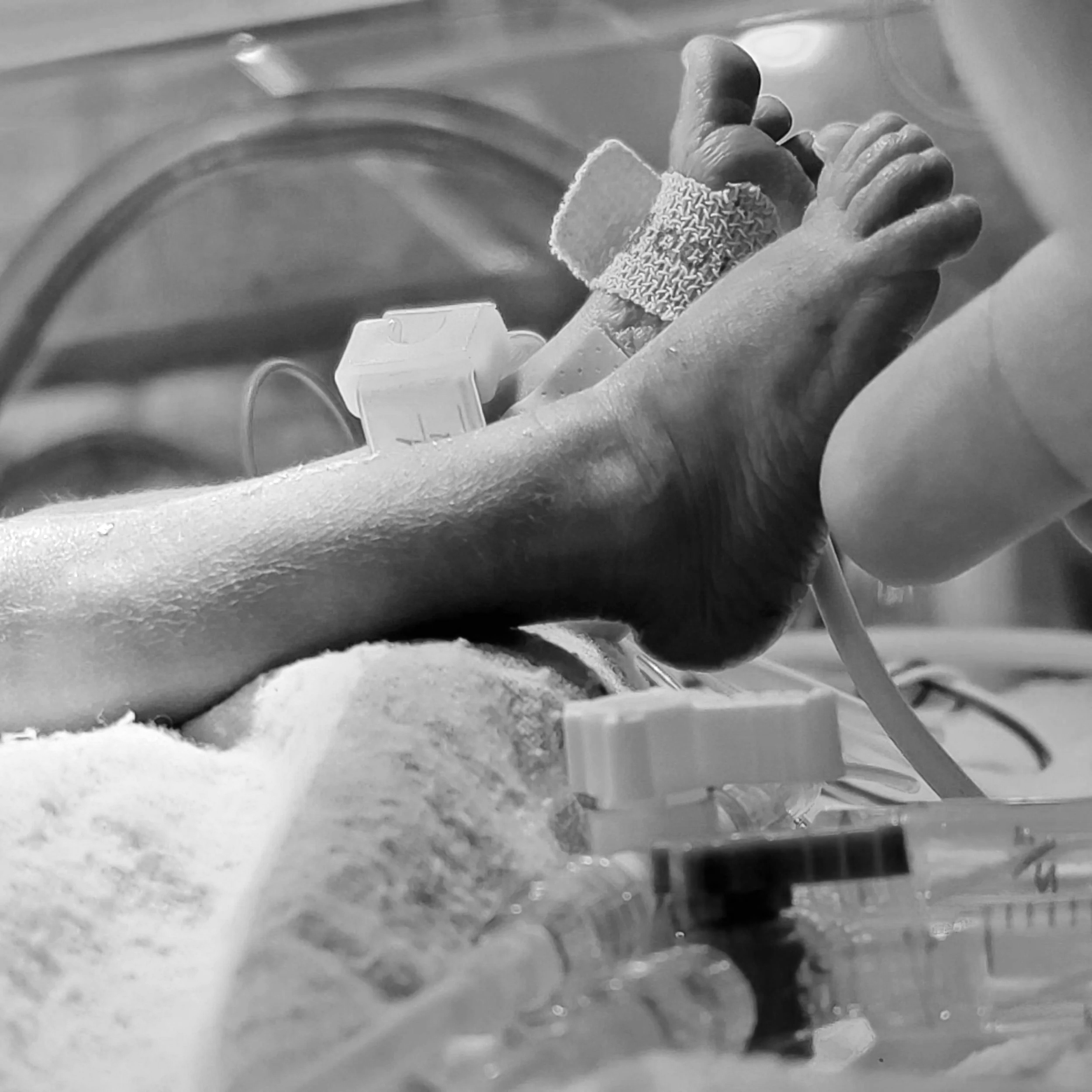
Navigating the NICU
The NICU Was Not What You Planned. What You're Feeling Makes Complete Sense.
You had a picture of what bringing your baby home would look like. This wasn't it. Instead you're driving to a hospital every day, learning a language of oxygen levels and feeding tubes and weight checks, sitting beside an isolette when you imagined a cozy nursery. You're terrified. You're exhausted. You're grateful your baby is alive and heartbroken that this is how it's going. And somehow you're expected to hold all of that while also functioning in the rest of your life.
NICU parents are among the most emotionally at-risk people in the perinatal period, and they are among the least likely to receive mental health support. This page is for you.
What NICU Parents Experience
No two NICU journeys are the same, a 5-day stay after a breathing scare and a 4-month admission for a 24-weeker involve very different experiences. But NICU parents across the spectrum share a constellation of emotional experiences that deserve acknowledgment:
Acute stress and hypervigilance: scanning for alarms, struggling to leave, difficulty sleeping even when you have the chance
Grief: for the birth that didn't happen, the newborn experience you didn't get, the early weeks that looked nothing like you imagined
Guilt: wondering if something you did or didn't do caused this, struggling with the moments when you needed to leave
Helplessness: your baby's life is in the hands of others, and there is very little you can do
Relationship strain: NICU stress puts enormous pressure on partnerships, and you and your partner may be coping in completely different ways
Anticipatory grief: for NICU parents whose babies have complex diagnoses or uncertain prognoses
Post-NICU anxiety: even after discharge, the hypervigilance often doesn't turn off; you may find yourself monitoring your baby obsessively, terrified of every sniffle
Research consistently shows that NICU parents are at significantly elevated risk for PTSD, depression, and anxiety, during the admission and for months or years afterward.
How Therapy Can Help During and After the NICU
Therapy during the NICU stay provides a dedicated space to process what you're going through in real time, before it accumulates into something heavier. We can work on stabilization and grounding tools to help you get through the hardest days, communication strategies for talking with your partner and your care team, and ways to be present with your baby even in an environment that feels foreign and frightening.
Therapy after discharge addresses the emotional aftermath, including NICU-related PTSD, the complicated transition home, and rebuilding a sense of safety and normalcy with your baby. Many parents are surprised to find that the hardest emotional processing happens after the discharge they worked so hard toward.
Whether your baby came home healthy, is living with ongoing medical needs, or you experienced the unimaginable loss of your baby, there is a place for your story in this work.
Frequently Asked Questions:
Navigating the NICU
Still have questions? Take a look at the FAQ or reach out anytime. If you’re feeling ready, go ahead and apply.
-
Now is actually a very good time, if you have any capacity for it. Processing your experience as it happens, rather than storing it all up, can prevent acute stress from solidifying into longer-term trauma. Therapy during the NICU stay also gives you stabilization tools you can use in real time: ways to regulate your nervous system when alarms go off, strategies for getting through the days when progress stalls, and a space to put the weight down briefly so you can keep going. Sessions can be flexible and brief if that's what you need right now.
-
Extremely common. NICU experiences are acutely stressful and can create significant distance between partners — especially if you grieve differently, cope differently, or have different levels of comfort acknowledging the emotional impact. Some couples find that one partner wants to talk about it constantly while the other wants to move forward. Neither approach is wrong, but the distance can feel frightening. Therapy can address this directly, both in individual sessions and, if you're interested, in couples work.
-
I am so sorry. If your baby died during a NICU stay, this space is absolutely for you. The loss of a baby who was alive, who you held, who had a name, whose numbers you watched, is a profound and specific grief. Please reach out. You deserve support that fully honors what you lost.
-
Perinatal mental health is my specialty, and supporting NICU families is a specific focus of my practice. I have extensive training and experience working with the particular emotional landscape of NICU stays, including the medical jargon, the specific fears, the complicated relationship with the nursing staff, the daily arithmetic of grams and oxygen levels. You won't have to explain the basics to me. I'm here to understand.